 |
2010 Exhibitions

Al Weber, Lower Yosemite Falls, 1965. Gelatin silver
print. Santa Barbara Museum of Art, Museum purchase, Photography Art Fund. |
Yosemite: Then and Now
October 2, 2010 - January 23, 2011
The bridge from the past to the 21st century is created in views of the majestic Yosemite landscape. Since the moment the first photographs of this natural wonder were seen, this unparalleled landscape became a photographer’s mecca. From the traditional views, made by Carleton Watkins and Eadweard Muybridge in the 1860s, to modern abstractions by David Stroup and Kate Jordahl, Yosemite is both sublime subject and spiritual metaphor.
In 1864 President Abraham Lincoln signed a bill preserving Yosemite, embracing nearly ¾ million acres. The photographs in this exhibition demonstrate not only the changing medium of photography but also the changing perception and meaning of this iconic national park, which has since been named a World Heritage Site.
Drawing from the growing collection of photographic images in SBMA’s permanent collection, the exhibition ranges from the 1860s to 2004 and includes mammoth-plate images by the pioneers of the 19th century, the well-known views of Ansel Adams in the 20th century, and the time-lapse images of Trevor Paglen in the 21st century.
|

Jacob Lawrence, Decommissioning the Sea Cloud, 1944. Watercolor on paper. Santa Barbara Museum of Art, Gift of Mr. and Mrs. Burton Tremaine, Jr. |
An American Century: 20th-Century Master Drawings from the Collection
October 9, 2010 - January 2, 2011
The anchor of the Reframing America series of exhibitions is An American Century, a look to the past of American art of the 20th century and SBMA’s significant collection of works on paper. Comprising more than 75 works, the exhibition represents some of the nation’s best artists across almost a full century. At every point of significant shifts in style and subject matter—from the realist works of the Ashcan artists to abstract modernists—SBMA’s collections contains major works by major artists. The exhibition represents a history of American art, surveying both the diversity of techniques and materials that artists may use when they draw, and the period when art production in the United States became internationally significant. The collection also has a strong California flavor, and is prosperous in drawings that document the ways in which California artists have explored their own preoccupations, until they arrived on the national scene in the last few decades.
|
|

Marion Post Wolcott, Jitterbugging in “Juke Joint,” Clarkdale, Mississippi, 1939. Gelatin silver print. Santa Barbara Museum of Art, Museum purchase with funds provided by Mercedes H. Eichholz.
|
American Modernism: Selections from the Permanent Collection
October 9, 2010 - January 2, 2011
Complementing the drawings in An American Century, this exhibition showcases photographs and paintings from the Museum’s extensive collection of American art. While An American Century surveys the whole century, the 37 works in American Modernism concentrates on the decades of the early 20th century, beginning in 1910. In that crucial period – the build-up to World War I and the turbulent years between the World Wars, both American artists and their audiences experienced modernity in very personal ways.
The exhibition features three sections: the modernists who explored landscape and nature as a way of retreating from industrial and urban change; the artists who explored the vernacular and colloquial forms of American culture; and an outsider artist, who strove to integrate his indigenous past with Southern Californian realities.
|

Tony de los Reyes, 1851, 2009. Ink and oil on linen.
Collection of Guy and Nora Barron.
|
Chasing Moby-Dick: Selected Works by Tony de los Reyes
September 18, 2010 - January 2, 2011
Tony de los Reyes carries the theme of merging iconic subject matter and historic aesthetic styles further in this exhibition of paintings, drawings, and sculpture. For the past five years, his attention has been fixated on what is referred to as the Great American Novel—Herman Melville's Moby-Dick (1851). The style of these works, which are the focus of this exhibition, references Abstract Expressionism and Minimalism, movements associated with rugged individualism and "pure" materiality. The depiction of various nautical imagery with various materials, including dark inks and bronze, alludes to the complex multiple perspectives in the narrative. Yet the most powerful effect of this work is its examination of Melville's epic as a mythic vision of America. The artist's distinctive comparisons of Ahab and the U.S. enhance the insatiable and potentially self-destructive nature of both.
|

Noah Davis, inBoil and Margaret, 2010. Oil on canvas. Courtesy of Roberts & Tilton, Culver City, CA.
|
Stranger Than Fiction: Narrative in Works by Selected Contemporary Artists
September 18, 2010 - January 2, 2011
This exhibition features works by 11 mostly young, mostly Southern California artists whose inspiration rises from both fact and fiction, and the surprising results of the conflation of the two. References to literature, history, allegory, and fantasy converge in these works, posing new fictions and realities, and challenging the fine line between both. Archetypal American subjects dominate these works, which range in reference from colonial history, to religious iconography, to 1970s literature and comics, and to contemporary film and pop music.
Artists represented in the exhibition are Eric Beltz, Dawn Clements, Erin Cosgrove, Noah Davis, Kerry James Marshall, Aaron Morse, Allison Schulnik, Jeni Spota, Devin Troy Strother, Frohawk Two Feathers, and Nicolau Vergueiro.
|
|

YOON, JeongMee, Seo Woo and Her Pink Things, 2006, from The Pink & Blue Project (2005–8). Chromogenic photograph. Museum purchase with funds provided by Photo Forum 2007, The Museum of Fine Arts, Houston.
Click here to view an interview with Karen Sinsheimer, SBMA's Curator of Photography, and David Starkey as seen on "The Creative Community."
|
Chaotic Harmony: Korean Contemporary Photography
July 3 - September 19, 2010
The first major exhibition in the United States of photographs made by contemporary Korean artists presently living in Korea, Chaotic Harmony: Contemporary Korean Photography opens a window to the dynamic photographic scene in the Republic of Korea, known in the West as South Korea. Bringing together work by 40 contemporary photographers, this presentation of 42 large-scale images surveys the range of contemporary issues through the themes of land and sea; urbanization and globalization; family, friends, and memory; identity: cultural and personal; and anxiety.
Within the exhibition, two distinct generations of Korean artists are represented: those born in the mid-1950s and 1960s, during a succession of military dictatorships when the country was still largely agrarian, and those born in the 1970s, predominantly in urban areas and who came into maturity in the new democratic era which began in 1987.
Co-organized by Karen Sinsheimer, Curator of Photography at the Santa Barbara Museum of Art and Anne Wilkes Tucker, The Gus and Lyndall Wortham Curator of Photography at the Museum of Fine Arts, Houston, this groundbreaking exhibition is not a presentation on “Koreanness,” although issues of cultural and personal identity are strong components. Rather, it is an attempt to identify Korea as a source of complex and stimulating visual ideas expressed through the medium of photography.
Everyday RealitiesJuly 3 - September 19, 2010
Photographs by artists who live on the Pacific Rim have been one major area of focus within the photography collection at SBMA. Recently, significant works created by artists who live in Japan, China, as well as the Americas have been added to the collection and exhibited at the Museum. This exhibition focuses on newly acquired works made by several young, dynamic photographers who live in the Republic of Korea. The astonishing transformation, and to some extent dislocation, that has taken place in South Korea over the past two decades is reflected in many of these images as photographers strive to give visual expression to the realities of contemporary life. While many of the works displayed here reflect the seismic shifts of a changing nation, others are inspired by the extraordinary and timeless beauty of the Korean landscape. The chosen artists, taken from a large field of promising young talent, represent the unique visual
voices being formed in the dynamic climate of South Korea.
Seoungwon Won's Installation: My Life
July 3 - September 19, 2010
In her installation titled My Life, Seoungwon Won creates a visual portrait of herself as graduate student, living in an apartment approximately eight square meters (the size of a solitary prison cell). In a re-creation of the apartment, Won will install photographs of all 629 objects that inhabited her claustrophobic space for four years. “Because only the objects that I needed and valued existed, the objects and myself were one and the same.” When she bought a new object, she had to throw away an object, a choice which was always distressing.
Toward the end of her stay, Won spent two days and one night recording the objects that persevered after four years of study in Germany. She wrote the profile of the objects next to the photographs which did not take long to recollect…”I ran into them everyday for four years.” The result was astonishing to the artist. “Everything about a person called Seoungwon Won, even things that I was not aware of, were displayed like a diary.”
Living in a such a confined space, an immigrant experience the world over, made Won dream of escape, an idea that echoes throughout her work. Viewing the container that held both the necessities of life and the boundless imagination of one young woman, offers the opportunity to reflect on the things that crowd individual lives, and perhaps to ponder where the spark that ignites artistic impulse lives.
|

Dan Christensen, Rana, 1968. Acrylic on canvas. Santa Barbara Museum of Art, Gift of Mrs. Betty Freeman.
|
Colorscope: Abstract Painting, 1960-1979
March 20 - August 15, 2010
In the early 1960s the popularity of Abstract Expressionism waned in favor of new modes of abstraction that delivered through a succession of museum and gallery exhibitions and articles in the mainstream press that continued through the decade. Post-painterly Abstraction, Color Field, Op Art, Hard-Edge, Lyrical Abstraction—these are names of some but not all of the fractures that abstraction experienced from the 1960s through the 1970s. There are clear as well as arguable differences among these genres, but central to them all is one factor—an emphasis on color.
Colorscope features a selection of paintings, mostly from the Museum’s permanent collection, that reveal innovative ways in which color was made essential during this pivotal time. The exhibition features a range of artists—from influential figures to under-recognized talents—manipulating hues that ebb, flow, blend, undo, and inspire. Artists: Richard Anuszkiewicz, Alice Baber, Jerrold Burchman, Dan Christensen, Roy Colmer, Thomas Downing, Lorser Feitelson, John Ferren, Helen Frankenthaler, Sam Gilliam, June Harwood, Hans Hofmann, John McLaughlin, Kenneth Noland, James Parker, Larry Poons, Ernest Posey, Paul Reed, Bridget Riley, John Seery.
|
|

Saint Mirabai, Pemji of Chitod, India, Mewar, dated 1838, color and gold on paper. Gift of Pratapaditya and Chitra Pal.
|
From India and Beyond: Gifts from Stephen Huyler and the Pal Family Collection
March 6 - June 6, 2010
Listen to an interview with Drs. Huyler and Pal on AM1290's Art and Antiques program with host, Elizabeth Stewart
Essentially ephemeral, many terracotta sculptures were made for daily use or seasonal festivals while others, such as those adorning monumental architecture, were intended to last longer. Because clay is abundant, inexpensive, and can be easily shaped and replaced, many of these sculptures are notable for their playfulness and imagination. Clay artisans in India continue the tradition to this day, improvising, experimenting, and fashioning sculptures with great spontaneity and vitality.
The Pal Family collection gift, dating from the 2nd century to the early 20th century, has greatly expanded the scope of SBMA’s collection of Indian pictorial art, including manuscript illustrations, miniature paintings, drawings, popular paintings from Orissa and West Bengal, and works from the British colonial period. It also includes important Hindu and Buddhist stone and bronze sculptures from Kashmir, Nepal, and Tibet as well as paintings from Myanmar (Burma) and Sri Lanka.
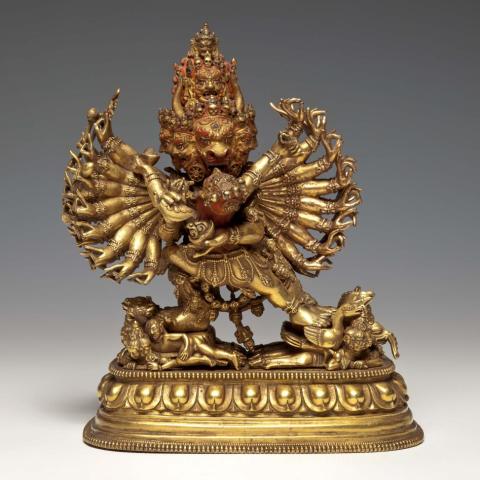
The examples of pictorial art usually illustrate the most significant cultural and religious tales. Goddess Durga is the consort of the Hindu god Shiva. Together, Shiva and Durga represent the male and female principles of the cosmos. The above, far right image, is a representation of Durga with both principles combined symbolically to suggest that they are in fact inseparable, a non-duality. The feminine face of Durga is shown with a beard and holding some of Shiva’s attributes —an hourglass-like drum, a trident, and a beggar’s bowl. She is not, however, without attributes to identify her as the great goddess Durga. In her hands one finds swords and a garland of white flowers as well as a voluminous scarlet pouch hanging from her left shoulder. Her animal vehicle, the lion, licks its paws, ready to give her a ride.
From India and Beyond celebrates the beauty and diversity of South Asian art through the distinctive visions of two scholars whose life-long collecting and generosity have so enriched this Museum. In recent conversations with the collectors, both Dr. Huyler and Dr. Pal expressed a growing sense of detachment from worldly possessions, in the spirit of Hindu and Buddhist teachings that led to the gifting of their collections.
Dr. Stephen Huyler grew up in Ojai and credits his lifelong fascination with the arts and crafts of India to the mentorship of his neighbors, F. Bailey Vanderhoef, Jr., late Trustee and major benefactor of the Museum, and Beatrice Wood, renowned ceramic artist. In 1986 at the Brooklyn Museum of Art, Huyler assisted in curating the first major exhibition devoted to the subject of Indian terracotta art, From India Earth:
400 Years of Terracotta Art. Ten years later, he published Gifts of Earth: Terracottas and Clay Sculptures of India (1996), an intensive study of the Indian potters' and clay sculptors’ art today.
Dr. Pratapaditya Pal remains one of the most influential forces in advancing the interest and understanding of South Asian and Himalayan art. Over a four decade long curatorial career, Pratapaditya Pal has been associated with the Museum of Fine Arts, Boston, Los Angeles County Museum of Art, Norton Simon Museum, Pasadena and the Art Institute of Chicago. Currently he is General Editor of Marg Publications, Mumbai. Dr. Pal characterizes his private collecting as driven by idiosyncratic preferences and, to avoid conflicts of interest, outside the main focuses of the museum collections he oversaw. Consequently, the Pal collection is diverse, offering fresh insight into the rich history of art and culture in South Asia.
|

Edouard Manet, At the Café, ca. 1879. Oil on canvas. The Walters Art Museum, Baltimore, Maryland (37.893, acquired by Henry Walters, 1909–10).
|
Delacroix to Monet: Masterpieces of 19th-Century Painting from the Walters Art Museum
January 30 - May 30, 2010
Assembled over a period of more than 140 years, the collection of the Walters Art Museum (Baltimore, MD) entails one of the finest holdings of 19th-century paintings in the United States. The only West Coast venue for the exhibition, the Santa Barbara Museum of Art is pleased to present Delacroix to Monet: Masterpieces of 19th-Century Painting from the Walters Art Museum, which includes 40 works from this renowned collection, selected for their art-historical significance and superior quality. Although strongly weighted in favor of French painting, this exhibition, like the collection, also includes major works by British, Spanish, and American artists.
Each painting is deeply satisfying on its own and displayed together, make for a ravishing exhibition that well captures the historical breadth and depth of the Walters’ collection, which was formed by father William T. Walters (1819-1894) and son Henry (1848-1931). While William focused his efforts on Barbizon school painting and academic stars such as Paul Delaroche and Ernest Meissonier, Henry sought to balance the collection by adding major works by earlier artists such as Eugène Delacroix and Jean-Auguste-Dominique Ingres, as well as by the Impressionists.
The selection reflects the depth and breadth of this collecting area of the Walters’ world-renowned permanent collection. Included are exceptional canvases representing all the major movements of 19th-century French art, from Neoclassicism through Impressionism. For example, Ingres and Delacroix, the leaders of the opposing schools of Neoclassicism and Romanticism, both derived inspiration from the past, but Ingres—the neoclassicist—looked to Greek and Roman antiquity and the High Renaissance in Italy, whereas Delacroix—the romanticist—turned to the Middle Ages and more recent history.
|
|
|